
Clarendon Court and JP Warrant Lookup Steps
Start with the citation itself. It names the court. A Clarendon ordinance case or municipal traffic ticket belongs to Clarendon Municipal Court, while a ticket routed to Donley JP 1 & 2 runs through that court's own channel. The two systems do not share a database.
- Gather the citation or cause number, full name, date of birth, and the court named on the paper.
- For a city case, open the Municipal Court Payments link from the official city court page.
- For JP 1 & 2, search by citation/ticket number or case/cause number through the official-linked nCourt page.
- Call the court if the portal shows a balance but does not answer whether a warrant or FTA is active.
- If the matter is not a city case, ask the issuing Donley court which office holds the record.
Clarendon Municipal Court Warrant Payment Route
Clarendon's official homepage is the hub city residents use. From there, the court page describes an impartial municipal court handling applicable state laws and city ordinances. It links "Municipal Court Payments" to a Government Payments vendor. That vendor page does not display its search fields, so ask the clerk whether it accepts payment on an active warrant, a payment plan, or just an ordinary citation. A paid balance alone does not mean the warrant has been recalled. Call the court at (806) 874-1448 about FTA, capias pro fine, a reset, or a required appearance.

Reach the payment link through the city's Municipal Court page. The official Government Payments portal sits outside the court website. Keep in mind that clearing a balance there does not recall the warrant.
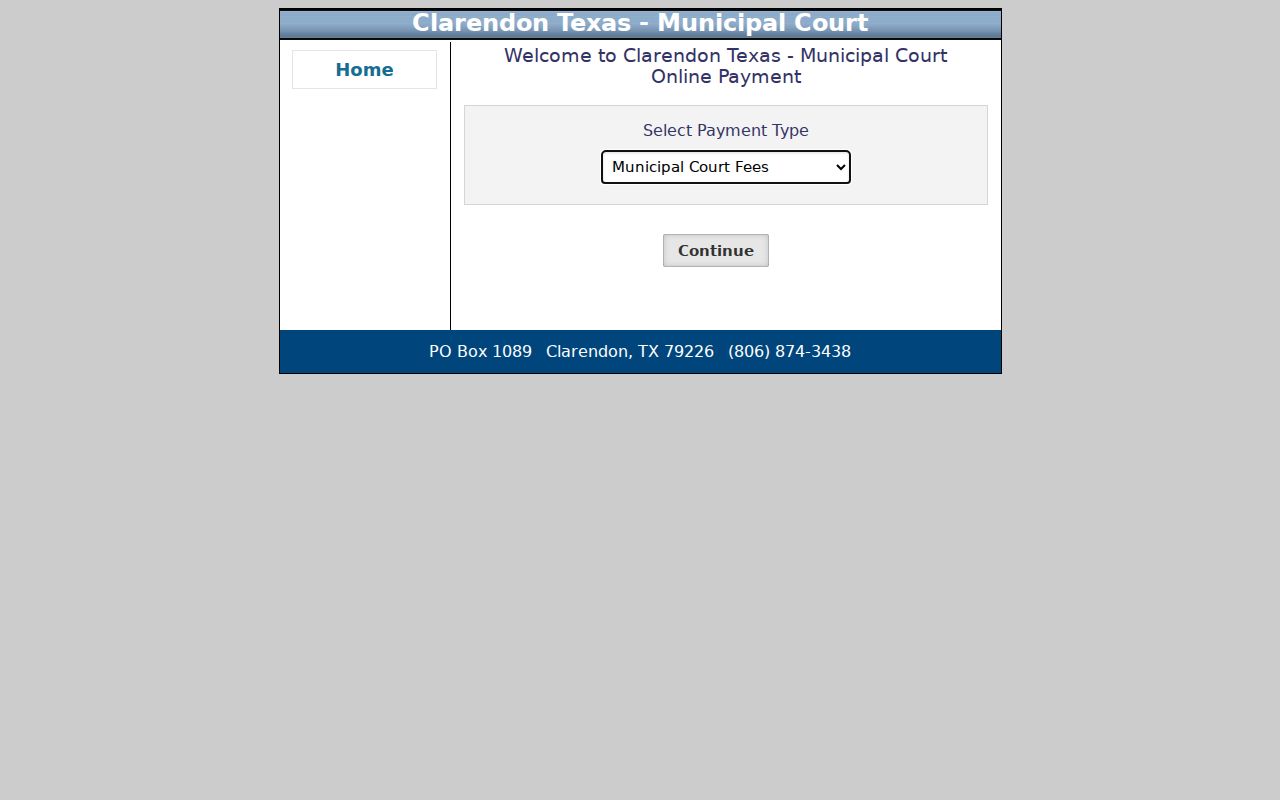
The vendor screen takes payments. It is not a warrant roster. Ask the municipal clerk about its case scope.
Clarendon Warrant Service and Municipal Court
Donley County's official Emergency page names the Sheriff's Department as primary law enforcement and dispatch for Clarendon. Clarendon posts no separate police warrant portal. For ordinance and traffic cases, the municipal court is the city source, and the OCA directory lists its contact as (806) 874-1448. Ask the court which officer or agency serves a particular warrant.
The county directory lists Constable Randy Bond at (806) 223-9247 and Sheriff dispatch at (806) 874-3533. Those numbers can route a serving-agency question, but the court still controls the Clarendon case.
Clarendon Warrant Courtroom Rules Before a Visit
Clarendon's procedures page asks visitors to follow the docket, wear proper attire, and obey courtroom direction. Phones go off. Photography and audio recording are prohibited, and no food or drink enters the courtroom. The page also lists a 3% convenience fee for Government Payments. Read the official procedures and fines page before you arrange an appearance.
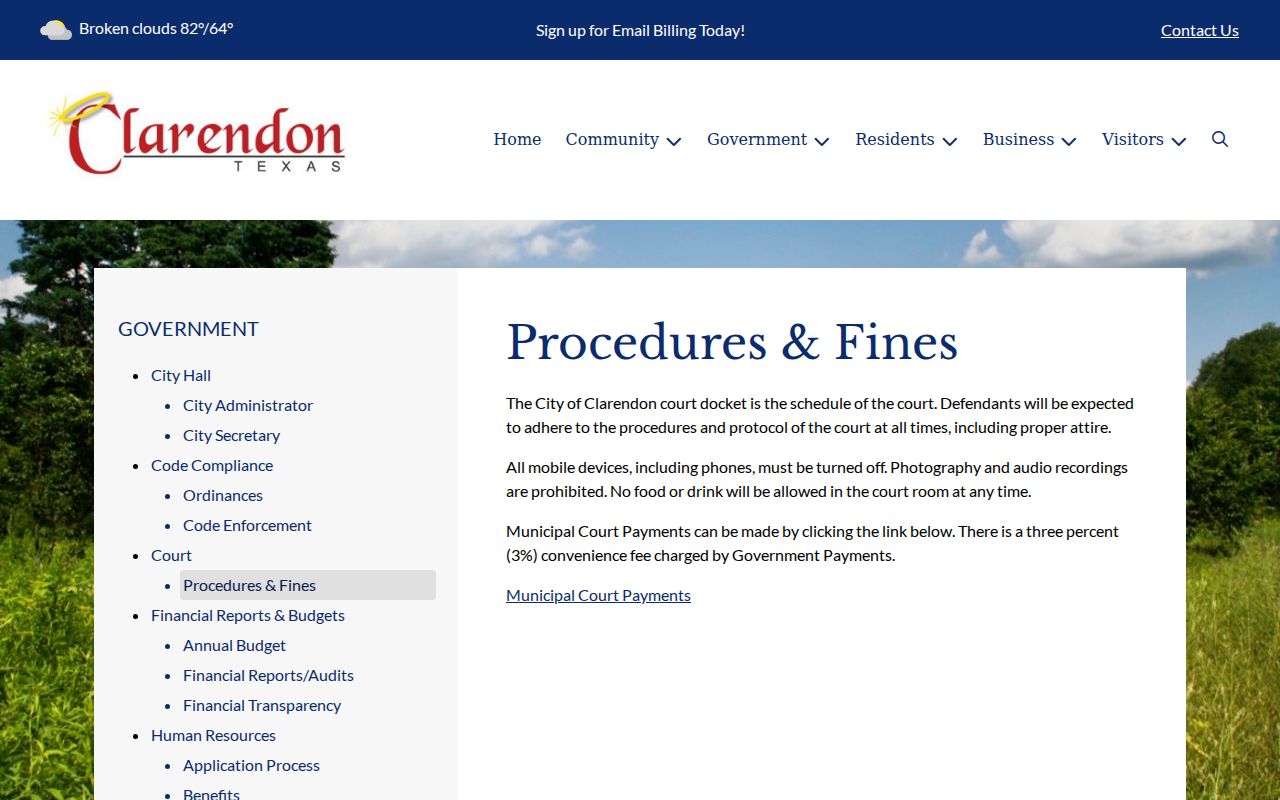
The procedure notice helps you get ready for court, but it gives no current warrant status, bond terms, or surrender time. Confirm those details with the clerk.
Clarendon Types of Court Warrants
One Clarendon ticket can come from traffic, an ordinance violation, a missed setting, or an unpaid judgment. Clarendon Municipal Court handles only its own cases. JP 1 & 2 keeps a separate case file, even when the ticket started inside the same city.
| Process | Possible city connection | First office |
|---|---|---|
| Traffic warrant | Missed municipal-court appearance or unpaid judgment | Clarendon Municipal Court |
| Ordinance process | City-code citation | Clarendon Municipal Court |
| FTA or capias pro fine | Failure to appear or satisfy a judgment | Issuing city court or JP |
| JP case warrant | Ticket routed to JP 1 & 2 | JP 1 & 2, not city court |
Clarendon Sully Street Warrant Offices
Clarendon sits as the Donley County seat, and its offices cluster within a block of one another. The County Courthouse sits at 300 Sully Street. JP 1 & 2 uses 309 S. Sully. A city public notice puts City Hall at 313 S. Sully. Close addresses do not make the records interchangeable, so check the court name on your paperwork before you walk to a counter. The city counted 1,877 residents in the 2020 Census, and its official homepage calls Clarendon the county seat's municipal center. For courthouse context, see the Donley County homepage, and confirm current counter details with the office before any visit.
What the Clarendon Case Inquiry Can Confirm
Clarendon posts no public sample warrant entry, and the city payment portal does not spell out its fields. Ask the clerk whether a result is a citation, a case balance, or an actual warrant record. Never assume a payment screen shows service, recall, or bond details.
| City case number | Use the citation or cause number printed on the paper; local warrant format was not published. |
|---|---|
| Warrant number example | Not published; use the citation or cause number instead. |
| Issuing court | Confirm whether the file is Clarendon Municipal Court or JP 1 & 2. |
| Process type | Ask whether it is an FTA, arrest warrant, or capias pro fine. |
| Balance | Confirm the current fine and costs with the court. |
| Status | Ask whether process is active, served, recalled, or needs a judge’s action. |
Clarendon and JP 1 & 2 Warrant Tickets
JP 1 & 2 is the justice-court route that sits near the courthouse in Clarendon. Its nCourt page lets you search by citation or ticket number, or by case and cause number. A citation may carry a letter, and if the search stalls, try the number without its leading zero. The portal asks for five days after a new ticket before you look, and it offers no name-and-DOB search path. If your number is missing or the status stays unclear, call Judge Sarah Hatley's office at (806) 874-2016. The payment line is (844) 680-7202. Remember that a JP result says nothing about a Clarendon municipal case. The county's official Justice page links the JP group and its payment route.
Clarendon City Warrant Record Requests
When the city portal leaves your records question open, contact Clarendon Municipal Court and ask where the city keeps the file. Donley County's Public Information Act instructions accept detailed written requests by mail, fax, or in person for county-held records. The city's own contact form carries a public-record notice, though Clarendon publishes no warrant-specific fee or processing timeline. For a county record, use the Donley County Open Records page and name the court, the citation number, the date range, the document, and how you want it delivered. A city request belongs with the city office that maintains the municipal case.
What Clarendon Warrant Callers Should Confirm
If a portal result comes back murky, press the court for specifics. Is the case municipal or JP? Was an FTA or a capias pro fine issued, and does a judge need to see you in person? Ask whether paying will actually recall the warrant. One more thing about money: Clarendon's 3% Government Payments convenience fee is a transaction charge, not a warrant amount. Before you drive over, confirm the right office, current hours, and courtroom rules, plus any surrender or bond instructions. Clarendon runs no walk-in warrant desk, posts no bond schedule, and its city police offer no warrant search page.
Where Clarendon Warrants Fit With Donley County
A Clarendon municipal case stays with the city court that heard it. A JP ticket routes to JP 1 & 2. A higher-court case may belong to the 100th District Court or County Court instead. Donley County publishes no countywide warrant roster, and Texas DPS's FTA/FTP program tracks court-reported license compliance rather than warrant status. For that county and state chain, start with the Donley County warrant records home page.
Public Record Access for Clarendon Court Cases
Texas law sets the public-access rules, but a city court file may sit with the city, not the county. Ask Clarendon Municipal Court for its record request route. Ask why any document is withheld. Executed arrest warrants follow a separate rule under Article 15.26; juvenile, sealed, unexecuted, or protected material may be restricted.
Texas access rules:
Government Code Chapter 552 is the Public Information Act framework.
For an already executed arrest warrant and its affidavit, Code of Criminal Procedure Article 15.26 describes the public-access rule.
Family Code Chapter 58 protects certain juvenile records from public access.